Understanding kWh
The kilowatt-hour is the universal language of energy. As the world electrifies—from EVs to solar panels—understanding kWh is becoming as essential as knowing kilometres or litres.

The Electrification Revolution
The world is rapidly shifting from fossil fuels to electricity. Electric vehicles are replacing petrol cars. Solar panels and home batteries are transforming how we power our homes. Cities are electrifying public transport and heating systems.
In this electrified future, the kilowatt-hour (kWh) becomes the "currency" of energy—the fundamental unit you need to understand to make informed decisions about your electricity bill, EV charging, solar generation, and battery storage.
Power vs Energy: The #1 Confusion
Power (kW)
Kilowatts = How Fast
Power is the rate at which energy flows or is used. It's measured in watts (W) or kilowatts (kW).
Water Analogy:
Think of power like the flow rate of water from a tap. A high-power tap delivers water quickly; a low-power tap delivers slowly.
A 2 kW kettle uses energy quickly
A 50 kW EV charger charges fast
A 6.6 kW solar system generates at that rate (when sunny)
Energy (kWh)
Kilowatt-hours = How Much
Energy is the total amount of power used over time. It's measured in kilowatt-hours (kWh).
Fuel Analogy:
Think of energy like litres of petrol in your tank. It's the total "fuel" you consume, regardless of how fast you use it.
Your electricity bill charges you per kWh
An EV battery holds 60 kWh of energy
Solar panels produce 25 kWh per day
The Simple Relationship:
A 2 kW kettle running for 0.5 hours uses 1 kWh of energy

What Does 1 kWh Look Like?
One kilowatt-hour is the amount of energy used by a 1000-watt (1 kW) appliance running for one hour. Here's what that looks like in everyday life:
kettle
Running for 30 minutes uses approximately 1 kWh
LED Bulb (10W)
Lit for 100 hours = 1 kWh
Average Home
Uses 20-30 kWh per day
Electric Vehicle
Drives 6-7 km on 1 kWh


Real-World Applications
Electric Vehicle Charging
Most EVs consume about 15-20 kWh per 100 km. A typical EV with a 60 kWh battery can drive approximately 300-400 km on a full charge.
Home Charger (7 kW)
Adds ~40 km range per hour
Full charge: 8-10 hours
Fast Charger (50 kW)
Adds ~300 km in 1 hour
80% charge: 30-40 minutes
Ultra-Fast (350 kW)
Adds 300 km in 10 minutes
Peak charging speed

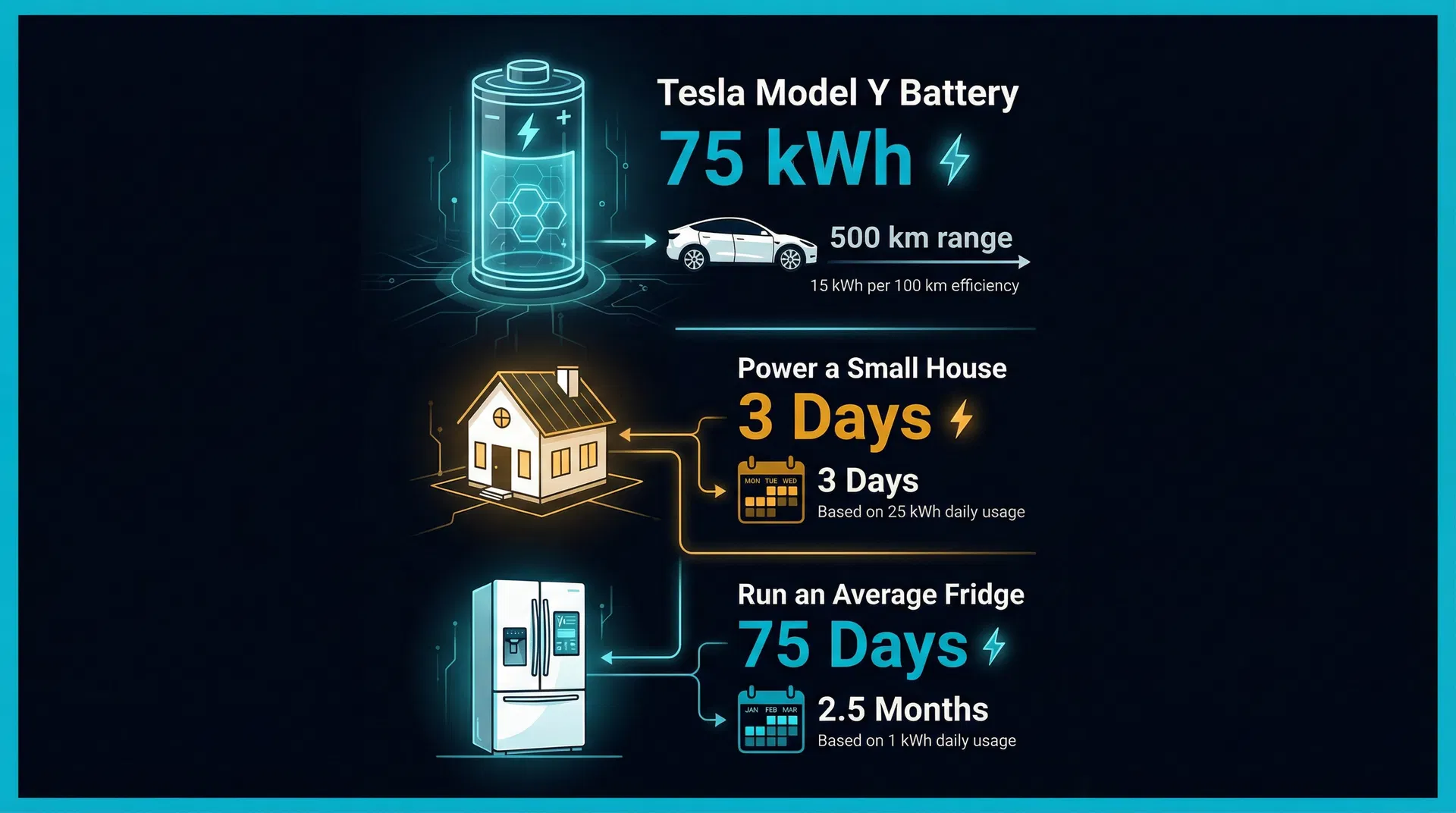
EV Battery Capacity: Putting 75 kWh in Perspective
A modern electric vehicle like the Tesla Model Y has a 75 kWh battery—enough energy to drive 500 km. But how much energy is that really? To help you appreciate the scale, here's what that same battery could power:
Driving Range
500 km
Full battery charge
Power a Small House
3 Days
Based on 25 kWh daily usage
Run a Fridge
75 Days
Based on 1 kWh daily usage
This illustrates why EVs are so efficient—the same energy that powers your home for 3 days can move a 2-tonne vehicle 500 kilometres. It also shows why "vehicle-to-home" (V2H) technology is gaining traction: your EV can serve as a backup power source during outages.
Solar Panel Systems
Solar panels are rated by their peak power output (kW), but what matters is how much energy (kWh) they produce per day.
6.6 kW System (Typical Home)
Produces ~25-30 kWh per day (sunny conditions)
Enough to power an average home and charge an EV
10 kW System (Larger Home)
Produces ~40-45 kWh per day (sunny conditions)
Can cover high usage and export excess to grid
Home Battery Storage
Home batteries store energy (kWh) from solar panels or cheap off-peak grid electricity for use later.
Tesla Powerwall 2
13.5 kWh capacity
Powers essentials for 12+ hours
BYD Battery-Box
10-20 kWh (modular)
Expandable capacity
Typical Usage
Evening peak: 5-8 kWh
Cooking, AC, appliances
Video Explainers
Short, visual explanations coming soon to our YouTube channel
What is a kWh?
The fundamentals explained simply
Coming Soon
Power vs Energy
Understanding kW and kWh
Coming Soon
EV Charging Math
Calculate your charging time and cost
Coming Soon
Quick Reference Guide
Common Conversions
1 kWh = 1000 Wh (watt-hours)
1 MWh = 1000 kWh (megawatt-hour)
EV efficiency: ~15-20 kWh per 100 km
Home usage: ~20-30 kWh per day
Electricity cost: ~$0.25-0.35 per kWh (varies by region)
Typical Power Ratings
LED bulb: 10W
Laptop: 50W
Fridge: 150W
Kettle: 2000W (2kW)
Air conditioner: 3500W (3.5kW)
EV charger (home): 7kW
Key Takeaways
kW (kilowatts) measures power—how fast energy flows
kWh (kilowatt-hours) measures energy—the total amount used
Your electricity bill charges you per kWh consumed
EV range depends on battery capacity (kWh) and efficiency (kWh/100km)
Solar panels are rated in kW, but produce kWh per day
Home batteries store kWh for use when needed
1 kWh ≈ driving an EV 6-7 km or running a kettle for 30 minutes
Understanding kWh helps you make informed decisions about energy costs